
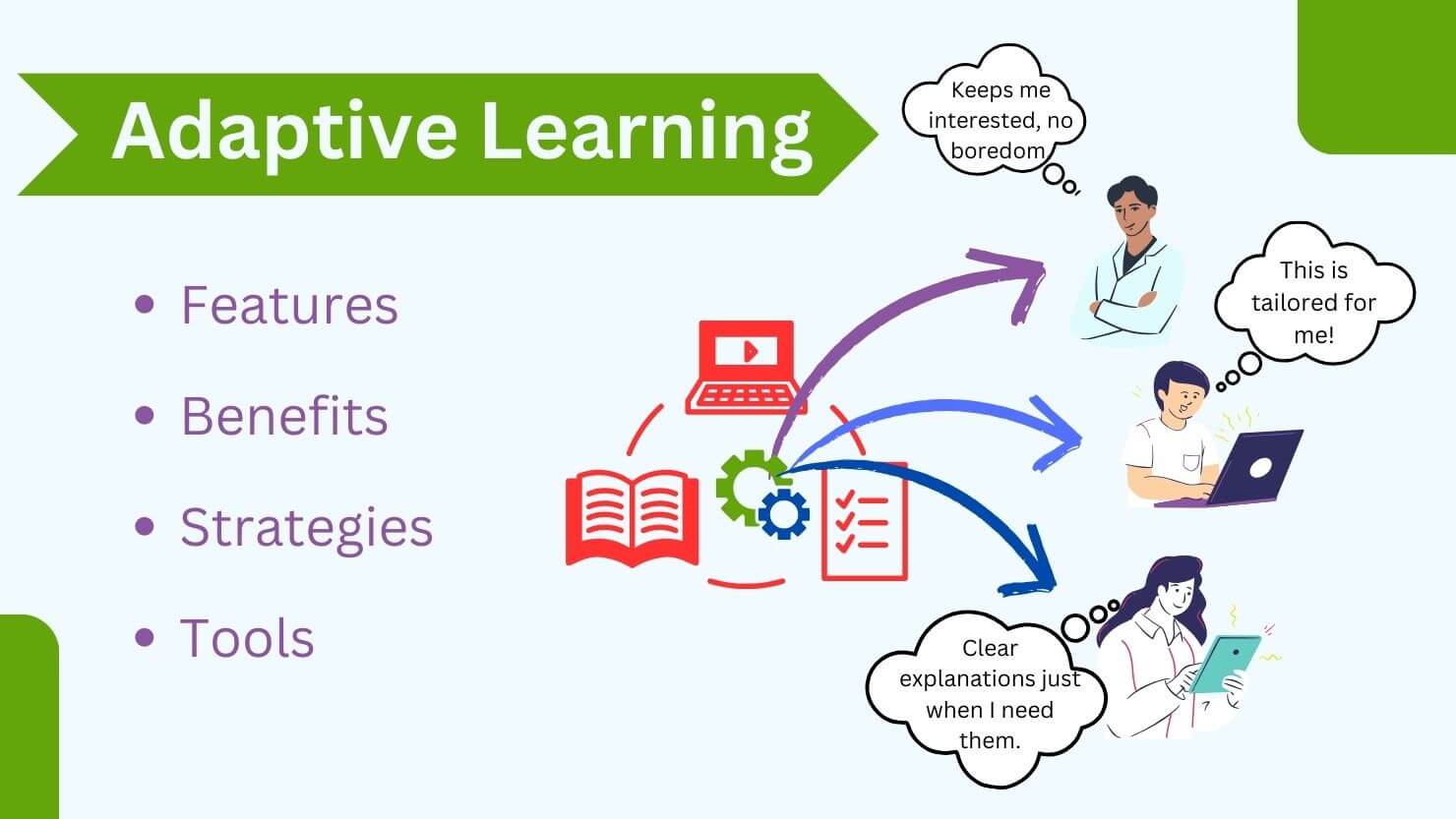
Training new employees is challenging; every employee has a different level of knowledge, skills, and learning abilities. Providing them with training content with a one-size-fits-all approach is not effective, and it creates a big problem. The content’s easier section is found to be boring to the learners who are already equipped with this knowledge. Learners who didn’t understand some of the concepts from the previous module are now having a hard time understanding the advanced module, which requires them to understand topics that they couldn’t understand previously. To overcome these challenges Adaptive learning is used in the modern day learning and development.
In this article, we will walk you through the concept of adaptive learning system, it’s benefit, strategies, how it is used to support different type of learners, you will learn about different tools that enables incorporating adaptive learning.
What is Adaptive Learning?
An adaptive learning system provides individually tailored content to each learner based on their assessment data. It uses real-time data analysis and monitors learners’ performance, strengths, weaknesses, and pace, then dynamically adjusts the curriculum and learning content to meet the unique requirements of each learner.
How it works
If you provide a group of learners with a course that is created with a one-size-fits-all approach and contains many modules. Some learners will find basic modules boring, as they already know a lot of information from these modules. Some might finish a module but forget key information and topics, leading to them struggling understand further modules that contain advanced topics. Here is how an adaptive learning system is used to overcome these issues:
- An adaptive learning system assesses all the learners right at the beginning.
- Analyzes each learner, their prior knowledge, strengths, and weaknesses.
- It tailors learning content for each learner.
- It asses learner throughout the course.
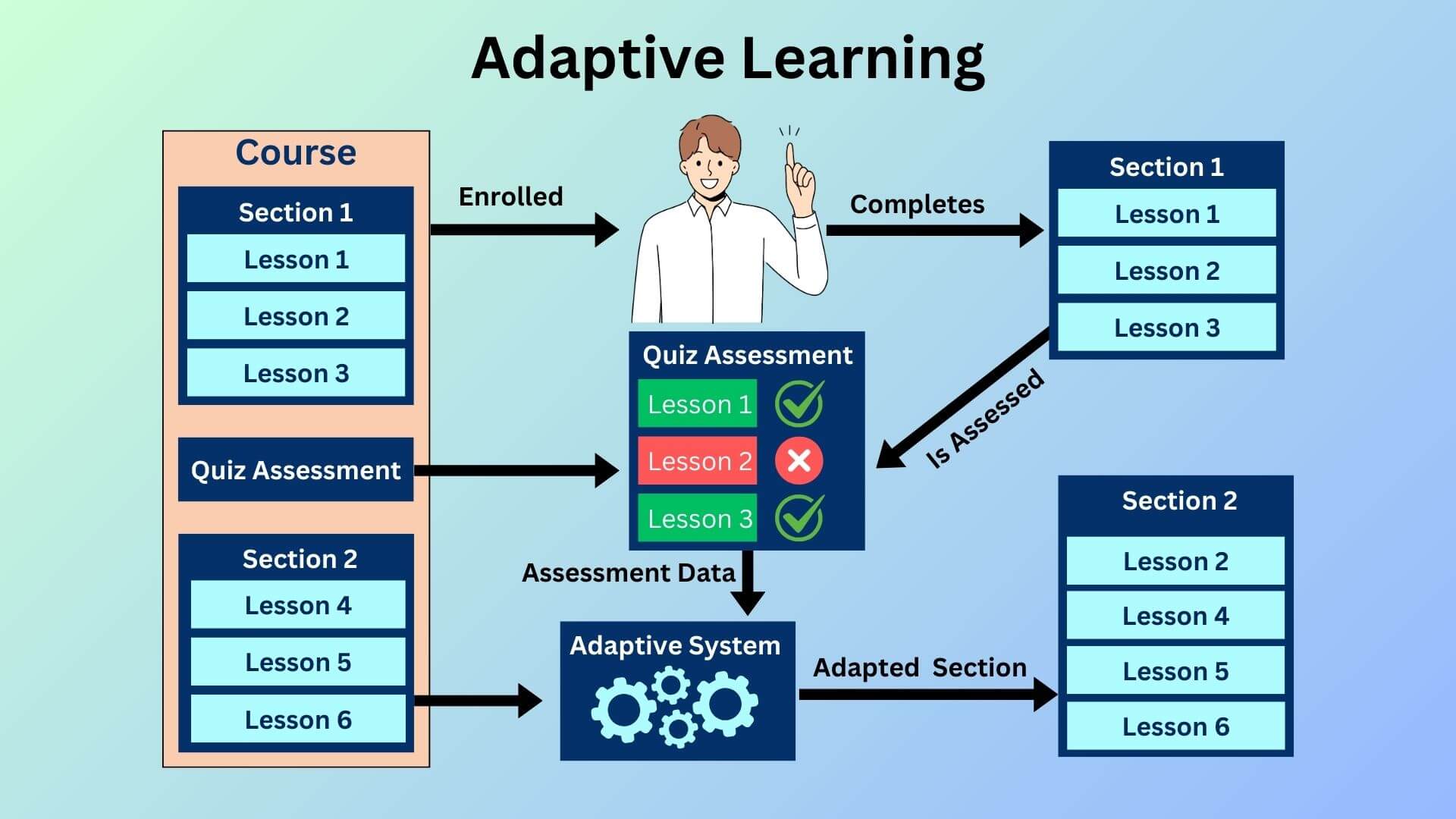
- It dynamically adds a micro lesson on a topic from the previous lesson that the learner needed to understand the current module, if the learner is struggling.
Look at the below image to see how adaptive system assess learner struggle with lesson 2 in the section 1, now that lesson is included in section 2 to support the learning.
Key Features of Adaptive Learning.
- Real-Time Adjustment: Learning content is dynamically tailored for different learners.
- Data-Driven Decision: It uses the learner’s assessment data, and analyzes them to decide the learning curriculum and what content to show to the learners.
- Individualized Learning Paths: Each learner experiences a different pathway based on their strengths and weaknesses.
Adaptive Learning Benefits
Adaptive Learning can be one of the best eLearning strategies to improve learning retention. It not only reteaches the basics to make the learners understand advanced concepts but also improves learner retention by making sure that the learners don’t find the content to be too difficult to leave.
Let’s take a look at its benefits:
- More Engagement: Learners engage more with the content as Adaptive Learning takes care of the issue of them being stuck at some point. It reteaches them the previous concepts if it is causing learners to not understand the current problem.
- Reduces Learning Time: It reduces the learning span as learners aren’t forced to learn a topic by themselves if they get stuck. It figures out the weak points with the assessment data and provides adaptive lessons to improve the learner’s skill that is required for the topic.
- Mastery: It makes the learners master the foundational topics by supporting them with adaptive lessons of the basics they are struggling with.
- Data-Informed Teaching: When you implement Adaptive Learning you work with data and this is where you can use tools like LRS (Learning Record Store) to analyze and see which part of the lessons, learners are having trouble with, you can pinpoint the reason and fix that.
Adaptive Learning Implementation Strategies
Adaptive Learning may also include some other strategies like micro-learning. Let’s take a look at what are the strategies and tools we need to implement an effective Adaptive Learning System.
- Assessment at the beginning: It is always a better idea to make Adaptive Learning work right from the beginning. And we need learner’s data for this to work so assessing them with quizzes at the beginning of the course will be a good approach. This will let the Adaptive System know about each of the learner’s knowledge and understanding of the topic.
- Use of Microlearning Strategy: In a simple word, microlearning is all about breaking the lessons into small chunks and teaching the learner piece by piece. This reduces the confusion of too much information at the same time. Adaptive Systems can use this small chunk of the lesson to reteach the learner if they forget that little information when they are into another topic of the course.
- Frequent Feedback: If the learner is found to be forgetting lots of basics then Adaptive Learning can be very annoying for bringing microlessons from previous topics again and again. So, frequent feedback may let them adapt right learning pace correctly, and get away from unnecessary relearning.
Some Adaptive Learning Tools
You can achieve Adaptive Learning to a certain extent with the help of Authoring Tools like Articulate Storyline, Adobe Captivate, and iSpring Suite. Let’s look at some of the tools that might be helpful in an Adaptive Learning System.
- Knewton: It uses machine learning to analyze assessment data and adapts the lesson for the required outcome.
- DreamBox: Focused on math, it is an Adaptive Learning platform primarily for K-8 education.
- Realizeit: It supports corporate training and higher education with a data-driven learning path.
- Conditional Addon: For WordPress LMS users, conditional addons can be a relief as there aren’t many Adaptive Learning options. Most LMSs like LearnDash LMS, Lifter LMS, WP Courseware, and Tutor LMS provide some sort of conditional or adaptive content addon to create condition-based Adaptive Learning. It won’t be similar to Newton’s machine learning-based Adaptive Learning but it still serves the purpose.
- GrassBlade xAPI Companion and LRS: These can be a powerful tool to track and store learning data for deep analysis and data-driven decisions for the betterment of course content.
Adaptive Learning Future with AI
We can see that AI is getting advanced more and more and affecting our lives in many aspects, It is going to change eLearning as well. eLearning professionals are already using Generative AI for eLearning content creation and for analyzing Adaptive Learning assessment data. With the evolution of AI, Adaptive Learning is going to be more advanced and robust.
Adaptive Learning is not just going to be predicting learners’ needs accurately, It also may leverage Generative AI to create content dynamically to provide learners with what they need to understand the lesson they are struggling with.
Conclusion
Adaptive Learning is one of the highly effective eLearning strategies that can be used along with other strategies like Gamification and Microlearning. It can create more engagement by taking away learning obstacles. Learners are more likely to complete a course with Adaptive Learning implemented than a simple course.
Adaptive Learning works right from the beginning by taking an early assessment of the learners, and then it creates a personalized learning curriculum for them. This makes the learning content less boring as learners won’t have to learn things they already know. So, Adaptive Learning would be one of the highly recommended strategies in modern eLearning education.
I hope this article has given you a complete picture of what Adaptive Learning is and how it will improve learning retention in your course or training program. Don’t forget to comment if any question you have, also share us with your strategy for implementing Adaptive Learning.
FAQs
Adaptive Learning is an eLearning approach that tailors learning content to individual learners based on their performance, strengths, weaknesses, and pace. It uses real-time data to dynamically adjust the curriculum and enhance learning effectiveness.
Adaptive Learning addresses the challenge of diverse learner needs by providing personalized content. It ensures learners engage with content suited to their knowledge level, improving retention, reducing frustration, and fostering mastery of foundational topics.
Adaptive Learning systems analyze learner assessment data to identify knowledge gaps. Based on these insights, they provide additional lessons, adjust the learning path, or skip content learners already understand, ensuring a smooth and personalized experience.
Yes, WordPress LMS platforms like LearnDash, LifterLMS, WP Courseware, and Tutor LMS can be used with additional conditional addons or pluugins for basic Adaptive Learning. These tools use logic-based content delivery but lack the advanced AI-driven capabilities.
Yes, Adaptive Learning can be integrated with strategies like gamification, microlearning, and simulations to create a comprehensive and engaging eLearning experience.