
The market of corporate training gamification is worth billions of dollars, driven by heavy investments in VR, AR, simulations, and interactive mobile learning. Despite gamification being adopted heavily, it is still struggling with the ROI crisis.
Thousands of dollars are spent by the organizations on immersive learning, only to measure their success by outdated metrics of the SCORM era, such as ‘completion’ and ‘final score’.
Basic gamification metrics such as points, badges, and leaderboards are vanity metrics; if you cannot definitively prove how a gamified learning module altered employee behavior, improved time-to-competency, or reduced real-world errors, then the fun in gamification is just an operational expense with no proven business value.
From Points to Performance via Deep Analytics
The solution is to focus on learner behavior. Instead of tracking the basic results such as points, badges, and leaderboards, track the process of play, which will be a lot more valuable.
When an employee engages with a gamified course, the final score tells you almost nothing about their competency. True ROI is found in the granular behavioral data:
- Decision Latency: How long did the user hesitate before making a high-pressure choice?
- Path Exploration: Did they deliberately explore alternative failure paths to learn what not to do?
- Attention Mapping: Where did they focus their attention? Rather than just tracking completion, tools like Advanced Video Heatmaps can reveal the exact seconds where learners repeatedly rewound a complex interactive scenario, pinpointing a specific knowledge gap across the entire organization.
By leveraging xAPI, organizations can map these micro-interactions directly to business KPIs, transforming a “game” into a high-fidelity behavioral assessment.
Architecting the Gamification Data Model
We will have to rely on eLearning specifications like xAPI to track learners’ behavioral patterns. Instead of just tracking pass or fail, the xAPI JSON payload will capture verbs such as attempted, abandoned, hesitated, or failed.
Furthermore, the context extensions in xAPI allow tracking specific, custom variables. Here is an example of an xAPI payload.
- Actor: John Doe
- Verb: Failed
- Object: Cybersecurity Phishing Simulation Level 3
- Result Extensions: {
- “time-pressure-status”: ”active”,
- “decision-latency-seconds”: 14,
- “retry-count”: 3
- }
Such an xAPI statement architecture demonstrates not just that John Doe failed, but why he failed (under pressure).
Mapping the Fragmented Ecosystem: VR, Mobile, and more
In modern-day gamification, learning doesn’t happen only inside the standard LMS environment. Today, most of the effective and immersive learning takes place across distinct technology stacks: ranging from mobile, tablet, VR, and more.
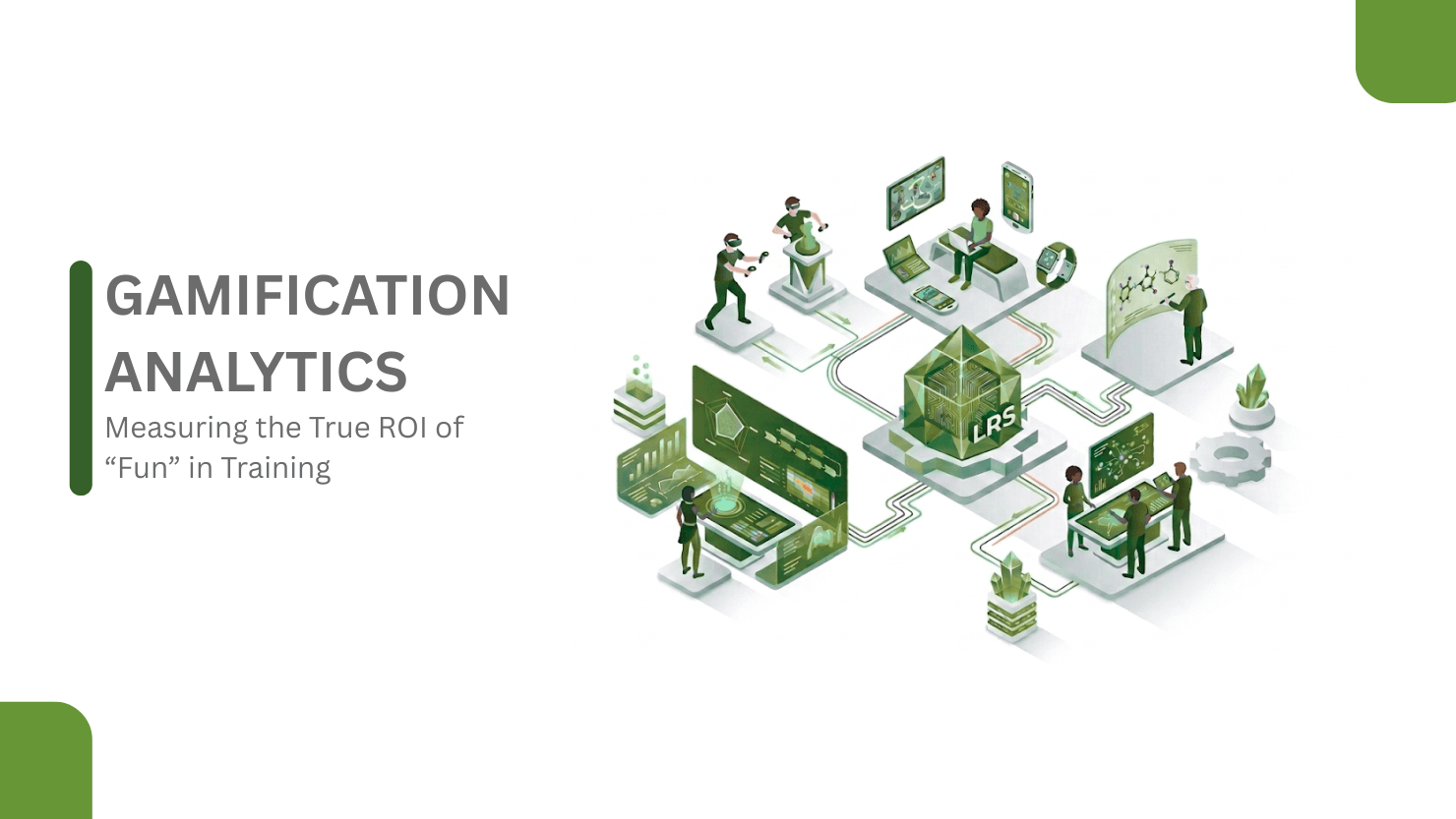
An xAPI ecosystem containing a centralized LRS allows you to send xAPI payloads from any gamified learning experience from any device. This enables learners to learn across devices. If a training course requires learners to switch devices, such as from a gamified web module to an AR simulation game on mobile, all the behavior is seamlessly tracked and stored in the LRS.
Predictive Talent Analytics: Translating Play into Business KPIs
Once you have successfully created an xAPI ecosystem for your gamified eLearning, the next step is to prove ROI with behavioral data by correlating it with business data.
Properly structured gamified analytics become more than a record of the past; they predict the future real-world performance. Learner’s behavior in gamified content can be mapped with the real-world key point of interest.
Risk Mitigation: If a learner group frequently shows increased decision latency and a high failure rate in a safety simulation, LRS data predicts a high probability of real-world compliance errors on the factory floor.
Visualizing Cognitive Overload: Rather than just relying on completion rate, tools like GrassBlade xAPI Companion can be used for their capability to track and send every interaction with a video to an LRS. Later, video heatmaps can be analyzed to pinpoint interactions such as pauses, replaying, etc., to know precisely where the training material causes overload.
Competency Mapping: In branching scenario simulations, learners’ decision pathways can be tracked and analyzed for their intrinsic motivation and problem-solving style. This allows HR to identify top-tier talent for leadership, which is based on behavioral data instead of just their pass, fail, and completion scores.
Conclusion
If your organization is still relying on traditional SCORM-like completion-based data for gamified training courses, you are missing out on determining the ROI of your training investment. Gamification is not limited to just making learning fun; in modern days, it is used to drive learning across the fragmented ecosystem of VR, AR, mobile, and more.
By upgrading your data architecture and creating an xAPI-based ecosystem, you not only connect the fragmented learning devices but also gain deep behavioral tracking of learners’ interactions. This allows you to correlate their behavior in the learning to their real-life performance or predict how they may perform.
This shift transforms basic learning records into predictive talent analytics, empowering leadership to mitigate real-world risks, identify cognitive overload, and map true employee competency. It’s time to look beyond the points, badges, and leaderboards and start translating learners’ behavior in gamified learning or “process of play” into measurable business value.