
The greatest lie in enterprise training is that employees have time to learn. In a corporate environment which can be a high velocity work environment, stopping an engineer, sales representative or an operations manager from their work momentum and forcing them to go to the Learning management system and click through the SCORM module is not a viable option. Studies show that employees drop off significantly when forced to switch applications just to find a piece of reference material.
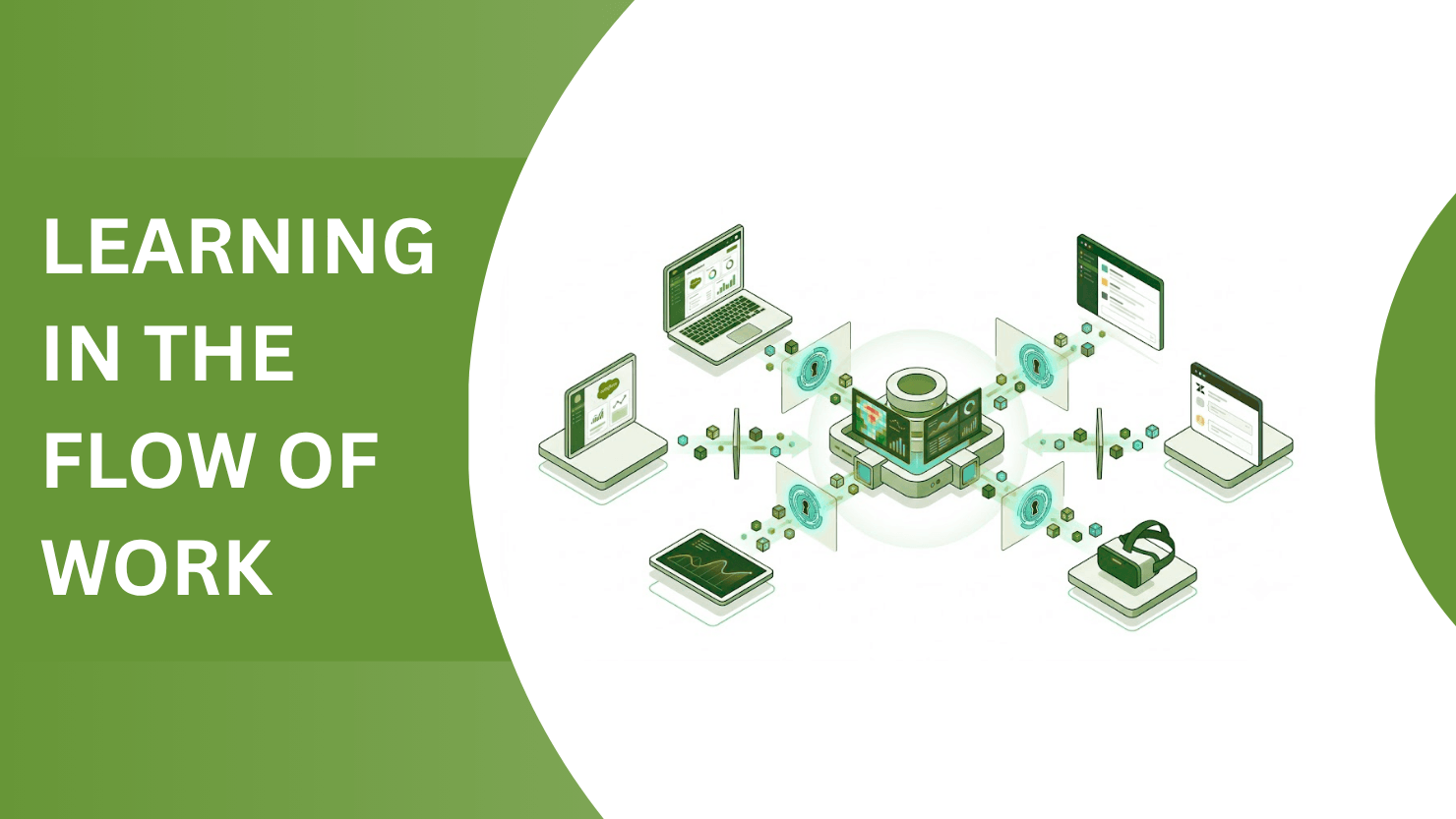
And this friction is bringing a strategic shift in the corporate elearning ecosystem which is Learning in the Flow of Work (LIFOW). This term was coined to describe the seamless integration of learning content for skill acquisition into the daily operation. Earlier it was about “How do we get people into our training program”, now LIFOW changed this into “How do we get our training resources into their daily software tools”.
What is LIFOW?
Learning in the Flow of Work is an invisible digital assistant. It’s a technique of delivering relevant training content directly in the software app where employees spend their day working. This prevents workers from focusing away from their task, they learn while working.
Such as:
- A sales representative is provided contextual micro-video about the new product and its feature directly inside the Salesforce while updating a lead record.
- A junior programmer or trainee faces a complex error code and instantly receives a targeted debugging guide within their software interface.
- A customer support replying in Zendesk gets an immediate prompt detailing an updated billing policy based on the customer’s query.
How xAPI Makes LIFOW Possible
Legacy standards such as SCORM require a strict web browser sandbox running inside a LMS to function; you can not implement a LIFOW ecosystem using such standards. If you are providing micro lessons in a custom build desktop app you can not track and record events using SCORM.
This is where xAPI steps in. xAPI’s Actor-verb-object framework allow you to capture any type of event from any device or application.
Because this event in a custom application is bypassing the LMS platform, event tracking data should directly be sent to the database and the Learning Record Store is the centralized database that enables such an xAPI ecosystem.
The Telemetry Payload
To see this in action, analyze this real-time xAPI JSON statement which reflects when an account manager opens an embedded interactive performance playbook:
JSON
{
  "actor": {
    "mbox": "mailto:johndoe@gblrs.com",
    "name": "John Doe"
  },
  "verb": {
    "id": "http://adlnet.gov/expapi/verbs/launched",
    "display": { "en-US": "launched" }
  },
  "object": {
    "id": "https://playbooks.enterprise.internal/sales/q3-objection-handling",
    "definition": {
      "type": "http://adlnet.gov/expapi/activities/media"
    }
  },
  "context": {
    "extensions": {
      "https://example.gblrs.com/xapi/ext/workflow_tool": "Slack",
      "https://example.gblrs.com/xapi/ext/active_opportunity_value": 45000
    }
  }
}
Notice how the payload tracks not just the event, but critical contextual data, such as the tool where the launch occurred and the specific deal value involved.
Transforming Telemetry into Operational Analytics
As LIFOW brings learning in the application employees spend time working, it also enables deep analytics capabilities that legacy platform and eLearning standards can not match. With xAPI you have to no longer rely on simple learning data such as course completion, pass/fail and duration, you now can track deep learner behavior and then correlate them with the employee’s operational performances.
Advanced Behavioral Visualization
Standard LRS solutions simply record a flat event stamp when a user plays a video. GrassBlade LRS changes this dynamic by processing continuous, granular interaction metrics.
Its processing engine converts raw data streams into visual tools like Advanced Video Heatmaps. This allows you to see exactly which parts of a micro-learning video an employee watched, skipped, or re-watched several times to solve an active workflow challenge.
High-Fidelity Performance Correlation
When you combine business performance metrics with granular learning telemetry in a central database, you can answer critical business questions:
- Did support agents who opened the billing policy video within Zendesk see a measurable drop in their average handle times?
- Do sales reps who review the product playbook close high-value opportunities faster than those who skip it?
Platform Selection: Finding the Right LRS Architecture
Choosing a right LRS to anchor a decentralized LIFOW strategy is one of the top priorities. Look at this comparison table between Multi-Tenant LRS and GrassBlade On-Premise LRS to decide which one suits your requirement.
| Architectural Challenge | Legacy Multi-Tenant Cloud LRS | GrassBlade LRS Architecture |
| Data Sovereignty & Control | Forces proprietary operational data out to external vendor clouds, conflicting with strict internal privacy rules. | Installable / On-Premise option. Runs natively behind your private firewall (AWS, Azure, Local) for absolute data isolation. |
| Client-Side Security | Relies on long-lived Basic Auth credentials, making client-side scripts vulnerable to credential harvesting and data spoofing. | Secure Token Framework. Uses short-lived, context-bound dynamic tokens to protect endpoints from tampering. |
| Ecosystem Versatility | Built primarily for standard web setups; requires complex middleware layers to ingest data from native apps. | Native Multi-Platform Ingestion. Connects easily to WordPress and Zapier. |
Future-Proofing Your Enterprise Strategy
If you are looking to transition towards LIFOW, it will require looking beyond traditional course delivery tools. You will need an infrastructure that provide you with learning data which can correlate the critical business intelligence
Review how your platform handles decentralized data before you launch your next training course:
- Identify High-Impact Systems: Pinpoint the core business applications where your teams spend most of their time (CRM, messaging tools, code repositories).
- Evaluate Ingestion Security: Ensure your data collection pipeline uses dynamic token authentication rather than exposed, static credentials.
- Choose a Scalable Storage Model: Select an LRS architecture that provides the deployment flexibility, data sovereignty, and deep interaction visualization required to map learning directly to business outcomes.
Conclusion
The shift to Learning in the Flow of Work (LIFOW) is more than a technological upgrade, it makes learning efficient while keeping the productivity of the employees less affected. And xAPI enables tracking across different platforms which could be outside the LMS, it provides granular data to compare with the business intelligence for employee’s performance analysis.
How have you integrated LIFOW in your training programs? Comment down and tell your story.