
Nowadays, the workplace is transforming with new technologies, business models, and customer expectations is increasing faster than ever before. Skills are becoming obsolete, and there is a continuous requirement for skill upgrades. In scenarios like this, traditional training is not very effective because its one-time training program fails to keep up with the rapidly changing workplace ecosystem and skill requirements. And this is where continuous learning steps in.
Continuous learning allows employees to adapt, stay relevant to the latest skills and trends, and grow within their roles. Continuous learning fosters curiosity, empowers employees to explore new ideas, it also becomes a natural part of everyday work life.
What is a Continuous Learning Culture?
In an organization, a continuous learning culture is a mindset where learning is an integral part of everyday work. The organization encourages employees to acquire new knowledge, refine their skills, and apply this knowledge to real-world challenges.
In a continuous learning culture:
- The organization provides learning resources that should be easily accessible in everyday work.
- Employees are encouraged to explore and innovate.
- Learning achievements and experiments are recognized.
Why Continuous Learning Matters?
Continuous learning allows employees to keep up with the fast-changing workplace tools, technologies, and methodologies. Due to regular upgrades in skills and up-to-date knowledge, employees feel more capable and confident in handling challenges. Employees who see learning opportunities within their organization are more likely to stay.
Why it matters for organizations:
- Higher Productivity: Employees with the latest skills and information are more efficient because they know how to use new technologies, they can streamline processes, and solve problems creatively, which results in the organization achieving higher productivity.
- Bridging Skill Gaps: A continuous learning culture bridges the differences between what employees know and what’s needed for the job to be done.
- Innovation Through Experimentation: Employees with the latest tech knowledge and skillsets are not afraid of experimenting and failing. And this psychological safety allows innovation potential.
According to a study by Deloitte, organizations with a strong continuous learning culture are 92% more likely to innovate, 52% more productive, and 17% more profitable than their competitors.
Example: A Learning Culture in Action
A software company notices that its employees are struggling with the rapid advancements in generative AI. The company launched a continuous learning campaign for weekly upskilling sessions. This is done by providing microcourses, tutorials, or peer-led sessions. The company also created a skill-showcasing wall where employees could showcase their newly earned badges or certificates.
This drives employees to learn and be part of the continuous learning campaign. It creates a competition between them, and as a result, they get better and are trained with the latest skillsets and information. This results in increased productivity in the company.
Key Elements of a Continuous Learning Culture
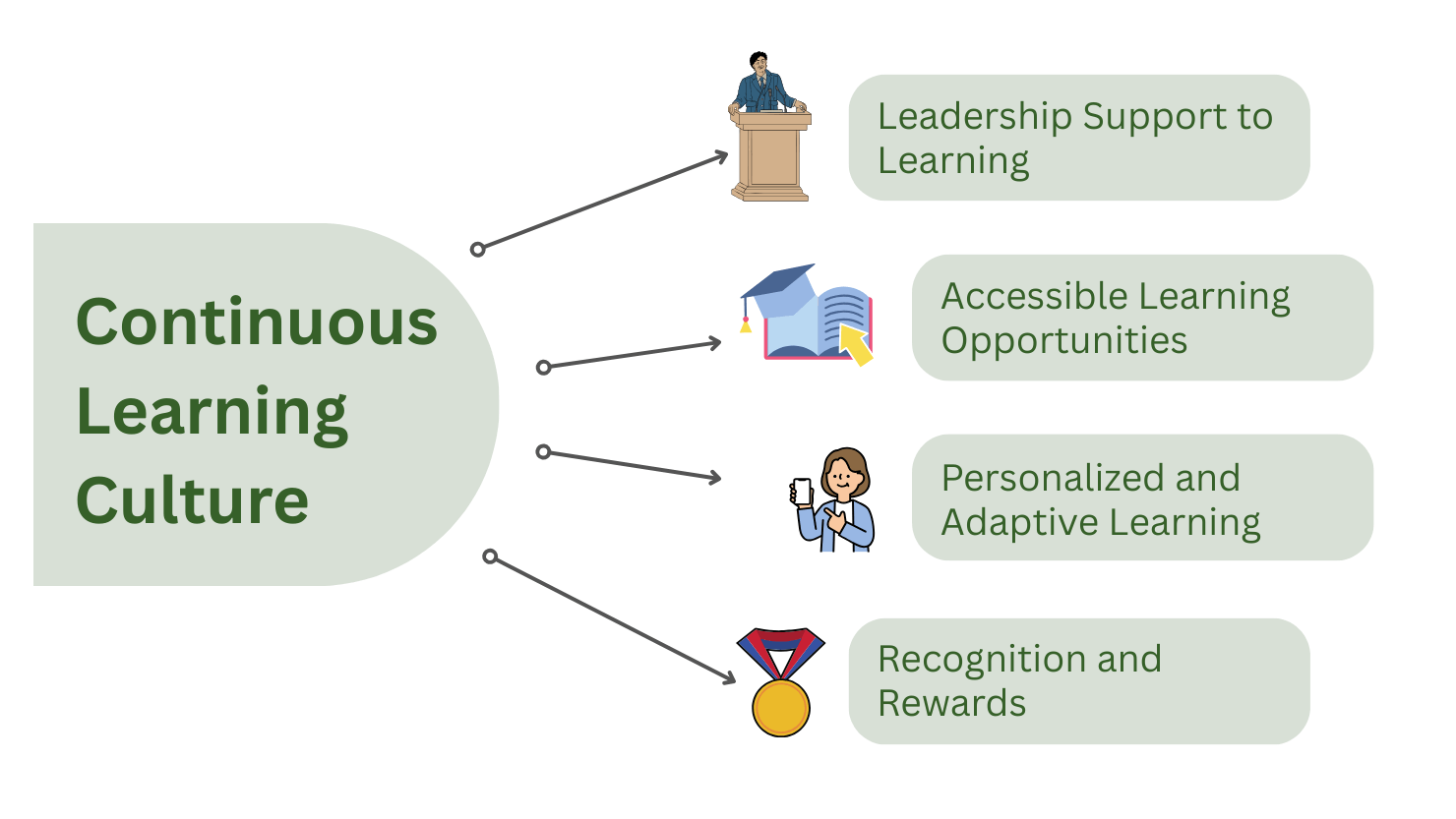
Leadership Support
A culture of continuous learning starts right from the leadership; they set the tone. If leaders won’t prioritize learning, employees won’t either. When leaders attend workshops, interact with learners, ask for feedback, share new insights, it signals that learning is valued. This helps remove the stigma of not knowing. Employees feel safer admitting skill gaps and they seek development opportunities.
Accessible Learning Opportunities
Learning shouldn’t be a burden, it shouldn’t be forced on employees, otherwise sometimes it becomes overwhelming to them. Instead, learning should be accessible and seamless. Employees should be able to access short lessons when they need them. It should be accessible on mobile so employees can access them anywhere, anytime.
Personalized and Adaptive Learning
Every employee will have different roles, so they should need different training. Learning should be personalized for different employees. Whereas it should be adaptive to their prior knowledge, preferred learning styles and goals.
Recognition and Rewards
When employees see their efforts acknowledged, they continue to put efforts in learning and also encourage others to follow. Public acknowledgment with certificates, badges, or shout-outs leads to building strong motivation.
Tools that support Continuous Learning
Learning Management System (LMS)
LMS is the most important tool that acts as a central hub of learning operations in an organization. It allows you to place all learning content and activities in one place which can be accessed by learners any time at their pace of learning.
LMS supports continuous learning with reminders, learning paths, and periodic assessments. Features such as microlearning, adaptive learning, scheduled refreshers, etc, allow effective learning.
Learning Record Store (LRS)
LRS stores tracked eLearning data and provides you deeper insights into how learners are interacting with your content, helps you to pinpoint where they struggle and enables you to improve content where learners were struggling.
Continuous learning requires continuous insights. LRS makes this possible by helping you analyze what learners clicked, how long they spent on a lesson or a specific part of content, how learners interacted with videos, where they paused, skipped, which part they replayed and how they performed on quizzes.
Authoring Tools
Authoring tools allow you to create media-rich highly interactive content. With the help of such a tool you can create scenarios, you can simulate what a learner may face in real-world task. And it allows you to send tracking data of every interaction to an LRS.
AR/VR Tools for Immersive Learning
Augmented Reality(AR) allows you to overlay contextual knowledge over tools and objects. This can be used to train learners with on-the-job with overlay guides about operating machines and more. Whereas Virtual Relaity(VR) can be used for simulating real-world scenarios without the real-world risks, such as workspace safety training.
Gamification Tools
Gamification tools allow you to add game-like elements such as points, badges, and leaderboard which boosts motivation and create a competition among learners
Gamification encourages:
- Repeated engagement
- Voluntary participation
- Competition or collaboration
- A sense of achievement
Best Practices for Continuous Learning
Start Small and Scale
Begin implementing on a small scale, maybe with just one department, project team or skill area. This minimizes risks while using a new learning approach and helps the organization. It also helps identify what works at the very beginning of the implementation.
Align Learning with Business Goals
Start with a clear goal, note down what you want to achieve. It could be customer satisfaction, reducing errors, enhancing leadership, or increasing sales. This ensures that your investment in the training has a measurable outcome.
Encourage Feedback
Actively gather inputs from the learners about their learning experience. Ask them what helps, what doesn’t, and what is missing. This allows you to improve training, ensures that learning reflects what employees need.
You can incorporate this with post-course surveys, quarterly learning feedback sessions or create suggestion channels in tools like Slack, Microsoft Teams, Discord etc.
Measure Learning and its Impact
Use tools like GrassBlade LRS and GrassBlade xAPI Companion to track learner interaction and their evaluation. You can track how learners are interacting with lessons, videos, where they are skipping, where they are taking more time, analyze how they are performing in assessments and real-world application.
This will allow you to pinpoint their struggle and improve your training. You will also understand and measure the outcome.
Foster a Growth Mindset
One of the most important aspects of a continuous learning culture is encouraging employees to believe that skills can be developed through learning, effort and practice, it is not fixed or limited.
It boosts motivation to learn, reduces fear of failure, and encourages experimentation.
Conclusion
With fast-paced technological shifts, there is a continuous requirement for an organization to keep their employees up to date with required skills. This is solved by incorporating continuous learning culture. To create lasting learning culture, organizations have to focus on leadership support, accessible learning, personalization and performance recognition with reward. You can use tools like LMSs, LRS, Authoring Tools, and leverage technologies such as AR and VR to make continuous learning more effective.
FAQs
A continuous learning culture is an organizational mindset where learning is embedded into everyday work. Employees are encouraged to regularly update their skills, experiment, and apply new knowledge to real-world challenges rather than relying on one-time training programs.
Continuous learning helps organizations adapt to rapid changes in technology, tools, and business models. It improves employee performance, bridges skill gaps, supports innovation, and increases retention by showing employees that growth and development are valued.
Traditional training is often event-based and one-time, while continuous learning is ongoing. Continuous learning focuses on short, frequent learning experiences, real-time skill development, and applying learning directly within daily work.
Common tools include Learning Management Systems (LMS) for content delivery, Learning Record Stores (LRS) for tracking learning data, authoring tools for creating interactive content, AR/VR tools for immersive learning, and gamification tools to boost engagement.